AWARD CEREMONY PRODUCTION Great shows don't react. They anticipate.
The projector drifted. The logo doubled on stage. 400 guests. Cameras rolling. CEO about to walk out. Here's what happened next — and the checklist that exists because of it.
Book Award Ceremony Production in DubaiAward ceremonies are not about gear. Every company renting decent equipment knows that. What they don't know is that the difference between a room that feels alive and one that feels like a corporate obligation is entirely in the 3 seconds between winner announcement and applause. Those 3 seconds are where the production lives or dies.
EchoLight produces award ceremonies across Dubai's hotel ballrooms — JW Marriott Marquis, Sofitel Downtown, Habtoor Palace — and the technical reality of doing this at the level Dubai's corporate clients expect is not a conversation most production companies are honest about. This is the checklist that comes from actually doing it, including the night a projector drifted alignment 40 minutes before the CEO Excellence Award and 400 guests were none the wiser.
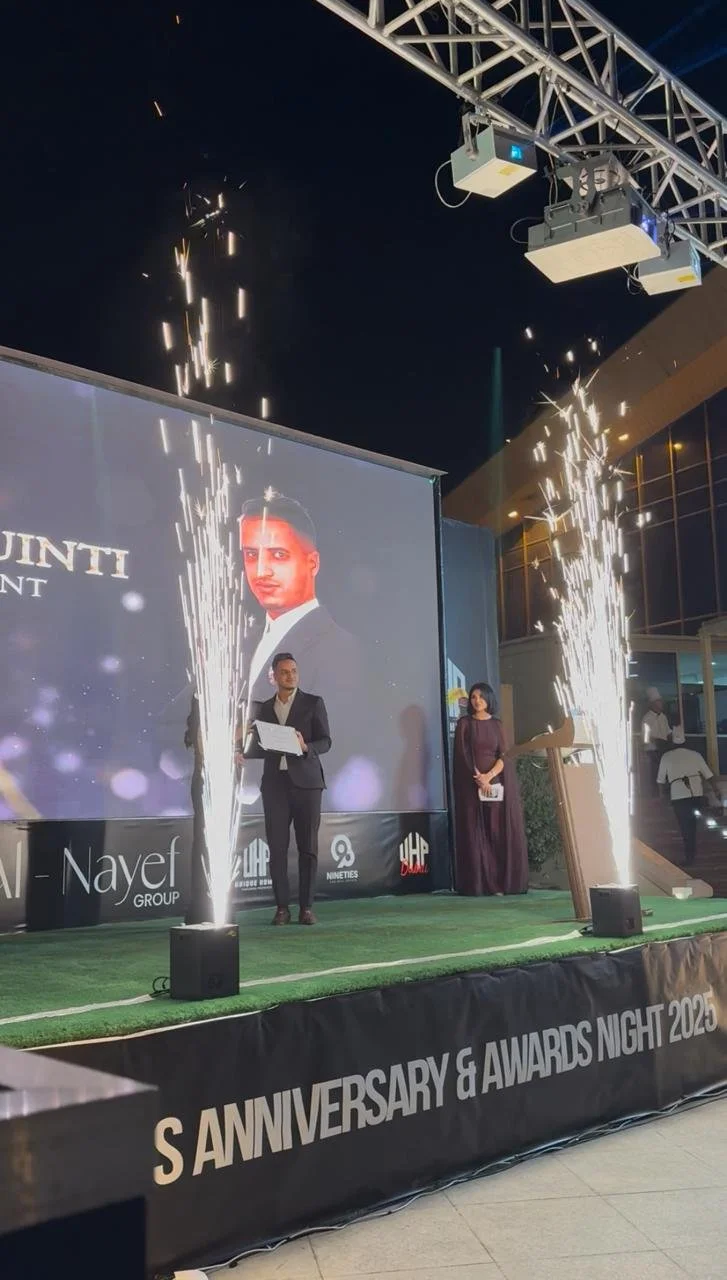
The Projector
Drifted.
Nobody Noticed.What happened at Novotel Al Bustan — and what it proves about production versus perfection.
Corporate awards night. Novotel Al Bustan ballroom. Around 400 guests. Layered stage panels built for depth. Standard corporate format — but produced at the level where every visual detail reads as intentional or amateur, and there is no middle ground.
Forty minutes before the CEO Excellence Award — the anchor moment of the night — one of the main front projectors drifted alignment. Not dead. Not visibly broken. Just slightly off. Which, in a mapped panel setup, is worse than a clean failure.
A dead projector gets noticed and forgiven. A drifted projector makes the logo edges look doubled, makes the projection lines stop matching the physical panels, and makes everything scream cheap — quietly, to every person in the first three rows, and clearly to every camera in the room. The audience wouldn't say it aloud. But you feel it. The illusion breaks.
The first row noticed immediately. Cameras were catching the misalignment.
That quiet tension started building — the kind where people don't know why it feels off, but it does.
No time to re-warp from scratch. No time to replace the unit. The CEO walks out in forty minutes.
Here is what actually happened:
Brightness pulled slightly down on the affected projector.
Tight key lights brought up on the presenter position — focus shifted to the human, away from the mapped surface.
Ambient spill on the panel reduced to deprioritise the misaligned zone visually.
Content framing adjusted on the fly to hide the error region rather than fight it.
Edge blend softened across the fault to read as design, not damage.
90% of the room never clocked it. Cameras stayed clean.
CEO walked out. Got his moment. Applause hit properly.
That's production. Not perfection. Control.
The lesson isn't about projectors. It's about the mindset that determines whether a production company survives a live failure or becomes the reason the event is remembered wrong. You are always one component away from a decision that defines the night. The checklist exists so that decision is already made before you're standing in front of it at 400 guests and a camera.
The Real Checklist
Item: Transitions.Not lighting. Not screens. Not gear. The 3 seconds between announcement and applause — that's where the room lives or dies.
Ask any event manager in Dubai what their award ceremony AV priorities are. They'll say LED wall content, stage lighting quality, microphone coverage. Those answers aren't wrong. They're just not where award ceremonies actually succeed or fail.
Award ceremonies fail in transitions. The 3 to 8 seconds between the moment a name is announced and the moment the winner stands at the podium. Do those seconds feel like rhythm — or like waiting? That question, multiplied across 20-plus award rounds, is the difference between a room that stays alive all night and one that quietly checks out by round seven.
Transition checklist — award ceremony production
-
Pre-programmed cue stack for every award round transitions — lighting shift, audio trigger, and content cue mapped together. One GO. No manual coordination between three operators mid-show.
-
Walk music trigger time agreed and rehearsed critical — not "when the winner stands up." Specifically: on the final syllable of the name. Rehearsed with the show caller and the audio operator in the same room before the event.
-
Lighting cue pre-loaded for podium position transitions — the stage look shifts before the winner arrives. The podium is already lit for them when they get there, not catching up while they stand in a dark spot.
-
Content server cue pre-built per award transitions — winner graphics, nominee reels, and award category content loaded in sequence. No manual file searching live on the media server.
-
Full transition rehearsal — not just a tech check critical — walk the entire run-of-show from announcement through podium through exit, timed, with the host. Once at full pace. This is where late music triggers get fixed.
-
Show caller briefed on every award's emotional weight transitions — the climax award needs 0.5 extra seconds of silence before the music hits. The opening award needs tighter timing to set pace. These are not the same cue.
Dubai Lights
for Two Audiences.
Most Forget One.The event is live for 400 guests. The footage is permanent for everyone who matters afterward.
This is the Dubai-specific reality that no generic award ceremony checklist written outside the UAE will account for: in Dubai's corporate awards landscape, the event is shot like broadcast television even when it isn't broadcast.
Stakeholders review the aftermovie. The CEO watches the social media clip. The sponsors request the internal comms edit. The footage doesn't forgive the same mistakes the live room does. And if you've lit the ceremony for in-room atmosphere only, cameras will crush your shadows, lose faces to overexposure, and render skin tones unpredictably across the full spectrum of Dubai's corporate guest list — white kanduras, dark suits, reflective dresses, every combination.
- Cameras crush shadows — faces disappear in dark scenes
- High contrast looks beautiful live, unreadable on video
- Skin tones shift between warm stage wash and cool LED
- Kandura whites blow out under uncontrolled key light
- The aftermovie looks like a different, worse event
- Consistent colour temperature across stage, audience, LED content
- Key light calibrated for camera exposure — faces readable at all skin tones
- Contrast manages within the camera's dynamic range, not beyond it
- Ambient spill controlled so backgrounds don't compete with faces
- Footage and live experience tell the same story
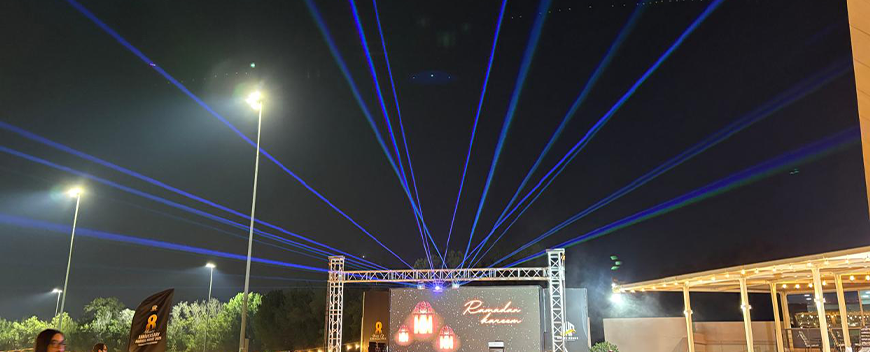
Camera-first lighting checklist — Dubai award ceremonies
-
Single colour temperature agreed across all sources camera — stage wash, audience fill, and LED wall content matched before the show. Camera white balance set once and held.
-
Podium key light tested on a human face — at camera critical — not checked from the console position. Tested through the camera viewfinder with a stand-in at the podium. Exposure confirmed. Shadows confirmed. Done before doors open.
-
Chandelier dimming agreed with venue — tested at show levels camera — Dubai hotel ballroom chandeliers produce a warm ambient that conflicts with stage colour temperature. Dimmer level agreed with venue operations, tested at show output, not assumed.
-
LED wall content colour-graded for the room's ambient camera — content that looks correct on a design monitor in a dark office reads differently against the ambient light temperature of a ballroom at event output. Test on the actual wall at the actual brightness before the event.
-
Camera positions confirmed — lighting designed around them critical — where the cameras are determines where the key light angles go. Get camera positions before final lighting positions are locked, not after.
Tell us your venue, guest count, and number of award rounds. We'll come back with a full production approach — transitions, lighting brief, and camera plan.
Protocol Moments
Are Not Creative
Moments.VIP entrances, national anthems, sponsor recognition — getting creative here is not bold. In Dubai, it reads as something else entirely.
Every Dubai award ceremony has moments where production creativity is not the right tool. VIP entrances. National anthem segments. Sponsor recognition sequences. Award rounds honouring government or institutional figures.
These moments require something that takes more discipline than creativity: stillness. Clean stage. Stable lighting. No dynamic effects competing with the moment. Full visual attention directed at the person or symbol being honoured — and nothing else happening in the room to dilute it.
-
All protocol moments marked in the show file as held states protocol — not a note to the operator. A locked cue state that requires deliberate action to leave. No accidental transitions during a VIP entrance.
-
National anthem timing confirmed with client — then confirmed again protocol — where it sits in the run-of-show, who gives the cue, how long the hold lasts before the next sequence. Not assumed from the brief. Confirmed in writing.
-
VIP entrance path lit — not as a creative moment, as a clear path protocol — the VIP walks in a clean pool of light that guides guest attention and reads properly on camera. Not dramatic. Dignified.
-
Sponsor recognition content reviewed by client before the show protocol — logo lockup, colour accuracy, display duration. Sponsor representatives will be in the room. They will notice.
-
Production team briefed: protocol = no improvisation critical — every operator knows which moments are creative and which are held. This briefing happens in pre-production, reinforced in rehearsal, confirmed before doors open.
Frequently
Asked.What event managers ask before booking award ceremony production in Dubai.
the room.
Tell us your venue, your scale, and what the night needs to feel like. We'll come back with a production plan that makes round 20 hit as hard as round 1.