LED Screen Brightness in Nits: What Your UAE Event Really Needs
By the EchoLight team · event production across the UAE · reading time ~6 min
Short answer: indoors, an event LED wall usually needs far less brightness than the spec sheet advertises, often just a few hundred to around a thousand nits at the level you run it. Daylight and outdoor sun are the only places where thousands of nits matter. Too bright is a real fault indoors: it glares, washes out on camera and tires the audience.
What a nit actually is
A nit is a unit of luminance, one candela per square metre (cd/m²), the same quantity brands may print as “brightness”. The candela per square metre page confirms nit is a non-SI name for it. On an LED wall it describes how much light the surface emits, not how well it looks in your room. A 5,000-nit panel and a 1,000-nit panel can both look fine in the same dim ballroom if the bright one is turned down, which is exactly what we do.
Two numbers matter on a quote: the panel’s maximum brightness, and the level we calibrate it to on site. The second decides how the event feels. Pair this with the resolution choice in our P2.6 vs P3.9 guide, because pixel pitch and brightness are separate decisions.
Typical brightness by venue
These are illustrative working ranges, not promises; they vary by product, content and ambient light. Always ask for the level the wall will be run at, not only the peak.
| Setting | Typical working level | Why |
|---|---|---|
| Dim ballroom or theatre | Roughly 300–800 nits | Eyes adapt to low light; higher looks harsh |
| Bright conference room | Roughly 600–1,200 nits | Competes with house lights and windows |
| Camera or livestream | Lower than the room feels | Cameras expose for the wall and band or wash out |
| Atrium, mall, exhibition hall | Roughly 1,500–3,500 nits | Skylights and general lighting |
| Outdoor in direct sun | Roughly 4,500–6,000+ nits | Sunlight overpowers anything dimmer |
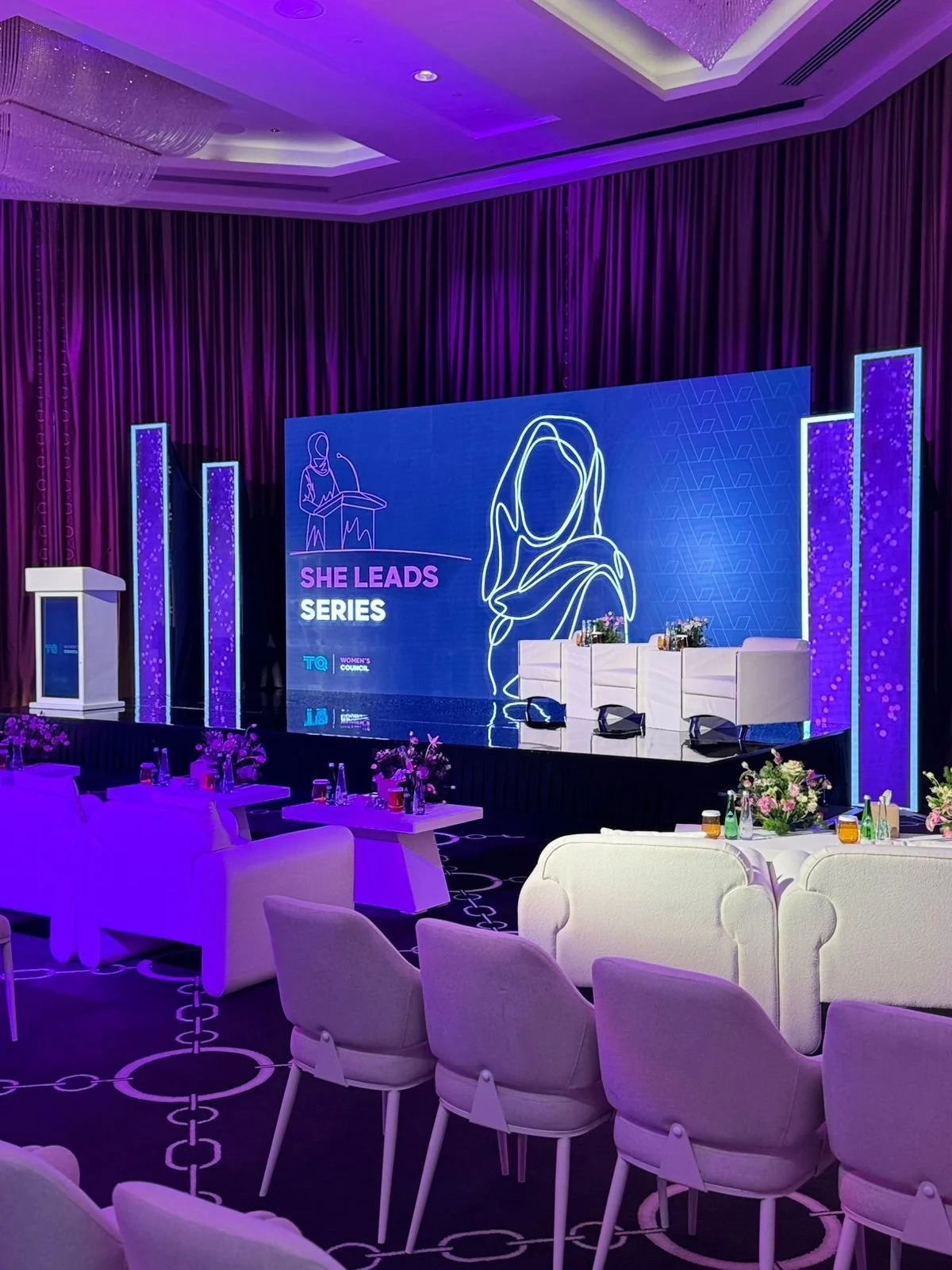
Why “brighter” can make the event worse
At night, in a dark room, a wall run near its peak becomes the brightest object by a wide margin. Guests squint, text blooms, and faces lit by stage lighting look dull next to it. Dimming also protects colour: most panels hold their best greyscale and colour accuracy below maximum output.
Cameras make this sharper. A bright wall in shot forces the camera to expose for the wall, so skin tones drop. Matching scan rate and shutter is a separate problem, covered in our camera-ready lighting guide. Keep the wall lower than the stage light on presenters, and treat contrast, not raw output, as the goal; contrast ratio is the part the eye reads first.
When high brightness is worth paying for
Peak output costs money: stronger LEDs, more power and more cooling. It earns its place in three UAE situations.
First, outdoor daytime use, such as a sports day, a ceremony or a launch before sunset. Direct sun can swamp a screen that looks perfect at night. Second, glass-fronted venues: atriums, hotel lobbies and mall courts where daylight floods in for most of the day, which we see on mall activations and exhibition stands. Third, events that run from afternoon into night, where the same wall must work in both conditions and be dimmed as the light drops. Plan for the sun’s angle: a screen facing west at golden hour is the classic trouble spot, which also matters for outdoor winter-season events.
Content and brightness work together
A large block of pure white content is the hardest thing for any LED wall, and the quickest way to feel glare. Dark backgrounds with controlled highlights look more premium and are easier on the audience. Slide decks with white backgrounds are better re-themed in dark colours; it costs nothing and usually looks better than turning the wall up. For general reliability risks, see common LED screen failures at UAE events.
Heat, power and the UAE climate
Higher brightness draws more power and produces more heat. Outdoors in summer heat, a wall run at maximum for hours is more likely to throttle or fail than one run at a sensible level. That is another reason not to chase peak numbers when the setting does not need them. If you are weighing screens against projection for a bright room, our LED vs projector comparison covers where each wins.
What it costs
Brightness is one of several drivers behind LED screen pricing, alongside size, pixel pitch, content playback and install. All figures below are typical production ranges excluding 5% VAT; see LED screen cost, LED screen rental and AV production costs for more.
| Typical scenario (illustrative) | AED excl. VAT |
|---|---|
| Lobby or small-room screen moment | 8,000–20,000 |
| Town hall or briefing with LED | 30,000–70,000 |
| Hotel gala with LED and lighting | 65,000–200,000 |
| Large LED-led or outdoor feature | 45,000–250,000 |
Higher-brightness outdoor panels usually push a project toward the upper half of its range. For packaged options, see event lighting packages.
Questions to ask before you book
Where will the wall sit and what light does it face? Will it be used in daylight, at night, or both? Is it filmed? What peak and calibrated nits does the supplier quote? Can they dim to a night preset? A good answer to all five means the screen is being fitted to your event rather than the other way round. To size lighting around the screen, see how many lights an event needs.
FAQ
How many nits do I need for an indoor event?
For a typical ballroom or conference room, a working level of a few hundred to around a thousand nits is usually enough, depending on house lights. The wall may be capable of much more, but we calibrate it down for comfort, colour and camera.
How many nits does an outdoor LED screen need in the UAE?
In direct sun, outdoor-rated panels in the 4,500–6,000+ nit range are typical because anything dimmer is overpowered. For evening-only events, a much lower level works and saves power and heat.
Does a brighter LED screen look better on camera?
No. A bright wall in shot makes the camera underexpose faces. For filmed or streamed events we run the wall lower and match lighting levels so presenters and screen both read well.
Is a higher-nit LED screen more expensive?
Usually yes, because stronger LEDs, power and cooling add cost, and outdoor-rated panels sit higher in the range. Indoor events rarely need that premium, so specifying correctly can lower the budget.